

💸 Earn Instantly With This Task
No fees, no waiting — your earnings could be 1 click away.
💸 Earn Instantly With This Task
No fees, no waiting — your earnings could be 1 click away.
Start Earning
Hollywood has long held a love-hate relationship with the spectacle, pageantry, and potential boondoggle represented by pirate movies. It’s an attraction and sometime repulsion perfectly befitting the antiheroic romance of pirate characters, right down to the fortunes that can be plundered and lost over the course of an adventure.
This dynamic stretches almost as far back as commercial cinema itself, and one of the most notable movies in this subgenre of action-adventure has just turned 100 years old. Even a century after is release on March 8, 2026 The Black Pirate remains an enduring example of why it takes more than a Cutthroat Island-sized bomb or later-period Pirates of the Caribbean-style diminishing returns to dissuade studios from returning to the high seas.
No offense to those Pirates of the Caribbean movies — particularly the eye-filling, Terry Gilliam-influenced muchness of the Gore Verbinski ones — but The Black Pirate keeps its story gratifyingly simple. After a vicious pirate attack on a ship, an initially unnamed survivor (original Zorro actor Douglas Fairbanks) washes up on an island and swears revenge for the murder of his father. When some of the same pirates turn up on the island, the survivor refashions himself as The Black Pirate to kill their captain, infiltrate their crew, and undermine their reign of terror from the inside. His efforts to do so involve showing off his athletic prowess as a buccaneer while saving lives, like that of a princess (Billie Dove) he encounters on a ship targeted by the pirates.
The fake pirate who also happens to be amazing at pirating is an irresistible story hook, maybe because it depends on making the wish-fulfillment subtext of pirate stories — sure, they do some bad stuff, but wouldn’t it be tremendous fun to try it out before dedicating yourself to the “right” side? — into the on-screen action. The movie is mostly about allowing the athletic Fairbanks to play pirate while ultimately still reading as an upstanding hero. That sense of line-blurring between boy’s adventure and man’s physical capability would inform adventure movies for, well, much of the next 100 years.
Part of the reason for The Black Pirate’s simplicity is that it’s a silent film, produced a year or so before The Jazz Singer put Hollywood on a path towards full-sound “talkies” as the new standard. Because The Black Pirate has no spoken dialogue, only a swashbuckling score, some modern audiences might be confused to realize that it’s also a color film. It’s easy to think of sound movies as largely predating color ones, because black-and-white photography remained dominant for several decades after silent films more or less died out. But experiments in color date back to the earliest days of film; they just weren’t always especially viable.
The Black Pirate was actually produced specifically to work as a color pirate movie. Back in 1923, the Indianapolis Star quoted Fairbanks as finding black-and-white pirate movies disappointing because “color is the theme and flavor of privacy.” This was three years before the release of The Black Pirate, reflecting the movie’s lengthy gestation. Though Fairbanks wanted to introduce color into a pirate movie, he also shared the prevailing thoughts about early use of color in the movies, namely that it was potentially a major distraction from what was actually happening on screen.

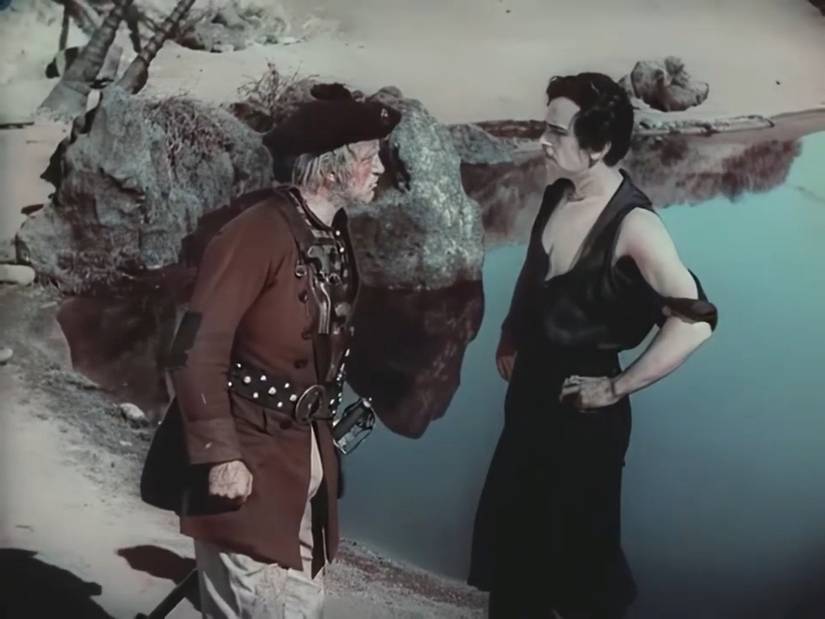
The film wound up using Technicolor’s two-strip process — a complicated technical practice that boils down to, “you can have some red and some green” — to create more subdued hues than past uses of film coloration, which tended to be saturated-looking tints. The Black Pirate has a surprisingly light touch with its color images, and the effect can vary: In certain shots, it looks shockingly naturalistic for its time, while in others it looks more like a painting, or a modern comic book intentionally limiting its color palette (like Superman: Red and Blue). It does appear to strike the right balance between offering a colorful portrait of pirate adventures without breaking the reality of its spectacular staging.
And despite that striking use of color, it’s Fairbanks combined with the teeming pirate masses that make The Black Pirate so eye-popping. There are multiple shots that seem to contain far more people than make up the entire cast of, say, recent pirate revival The Bluff (fun as it is), including a moment where a seemingly infinite supply of soldiers lend a hand to progressively lift the Black Pirate through a ship like a human-hands elevator.

Fairbanks does some impressive vertical movement on his own, too. The movie features multiple instances of (and is generally assumed to have created) the classic pirate move where you stab a knife into a sail and ride it down to the deck. The reason this is almost certainly from this movie and not real life is that doing this would probably not actually work; the fascinatingly complicated illusion involved some combination of a tilted sail (and correspondingly tilted camera), pre-ripped fabric, and hidden wires and counterweights.

It’s that level of effort that makes The Black Pirate so watchable 100 years later: It doesn’t look “real” exactly, with its particular color palette, sped-up action, and ships that rarely appear to be on genuine seascapes. But the work of the illusions is not only effective in the moment — it truly does look like Fairbanks is sliding down the sail of a boat using a knife — but spectacular unto itself. It’s not necessary that a big pirates-versus-soldiers melee includes a shot of dozens of weirdly outfitted soldiers swimming in sync toward the boat, but it has the majesty of a lavish musical in the middle of an action-adventure picture. Maybe that’s why Hollywood keeps braving the difficulties of shooting on water, costuming dozens of extras, and risking their dubloons: The Black Pirate makes the case that pirates are perfect subjects for pure cinema.
Being a public domain film, The Black Pirate is streaming for free all over the internet, from Tubi to Amazon to the Roku Channel to a decent copy hanging out on good old-fashioned YouTube.
💸 Earn Instantly With This Task
No fees, no waiting — your earnings could be 1 click away.
Start Earning